What You Need to Know About Disc Injuries After a Car Crash
If you’ve recently been in a car accident and are experiencing back or neck pain, you may be dealing with a herniated disc — one of the most serious and common injuries that car accidents can cause. A disc herniation can have long-lasting effects on your quality of life, your ability to work, and your financial wellbeing. This article walks you through everything you need to know: how car accidents cause herniated discs, what symptoms to watch for, how diagnosis and treatment work, and what legal rights you may have. Whether you suffered a herniated disc weeks ago or are just beginning to notice symptoms, this guide is worth reading.
How Do Car Accidents Cause Herniated Discs?
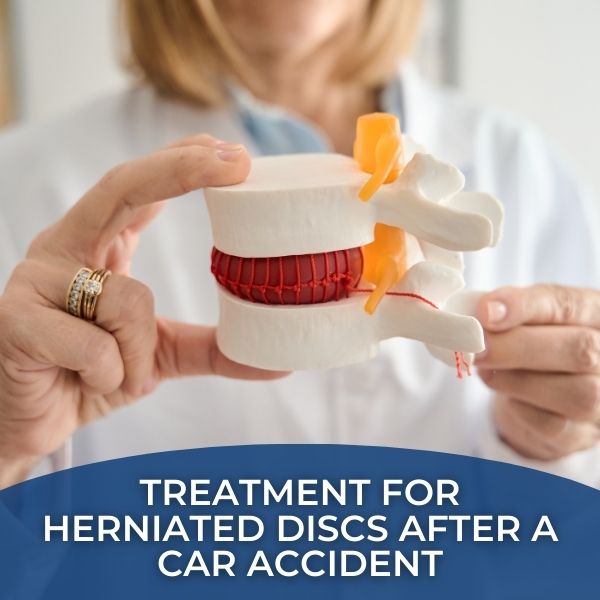
The spine is made up of vertebrae cushioned by intervertebral discs — small, rubbery pads that absorb shock and keep the spine flexible. Each disc has a tough outer layer called the annulus and a soft, gel-like center known as the nucleus pulposus. When you’re in a car accident, the sudden force of a collision can cause intense trauma to the spine, compressing or twisting the vertebrae in ways the body simply isn’t designed to handle.
When that force is severe enough, the gel-like interior of a spinal disc pushes through a tear in the outer layer — this is what’s known as a disc herniation. Car accidents can cause herniated discs in virtually any part of the spine, but the cervical spine (neck) and lumbar region (lower back) are the most vulnerable. Even a relatively low-speed rear-end collision can generate enough force to result in a herniated disc.
What Is a Herniated Disc, Exactly?
A herniated disc — also called a slipped or ruptured disc — occurs when the spinal disc’s inner material bulges or ruptures outward. This bulge can press against nearby nerve roots or even the spinal cord, triggering pain, weakness, and neurological symptoms throughout the body. The severity of a herniated disc depends on how much of the disc’s material has escaped and which nerve structures are affected.
It’s important to understand that a herniated disc is not the same as a disc that simply shows wear from aging. Disc injuries from car accidents are typically acute and traumatic. A disc after a car accident may look dramatically different on imaging compared to a healthy disc, because the force of a collision accelerates damage that might otherwise take years to develop — or might never occur at all.
What Are the Most Common Symptoms of a Herniated Disc After a Car Accident?
Symptoms of a herniated disc can vary depending on which part of the spine is affected and how severely the nerve is compressed. The most common symptoms of herniated disc injuries include sharp or radiating back pain, numbness, tingling, and muscle weakness. Pain and numbness may radiate from the neck down into the arms and hands (cervical herniation) or from the lower back down into the legs and feet (lumbar herniation).
Many people make the mistake of dismissing early symptoms as ordinary soreness following a car accident. However, symptoms of herniated disc injuries often worsen over hours or days as inflammation increases. If you notice persistent numbness, shooting pain, or weakness in your limbs following a car accident, seek medical attention immediately. Early diagnosis can significantly improve your outcome and strengthen your car accident claim.
Can You Have a Herniated Disc Without Knowing It Right Away?
Yes — this is one of the most important things to understand about disc injuries. A herniated disc from a car accident does not always cause immediate pain. The adrenaline released during and after a collision can mask pain signals, and inflammation may take 24 to 72 hours to fully develop. Some people don’t notice significant back pain or numbness until days after the accident.
This delayed onset is why medical professionals and personal injury lawyers consistently advise accident victims to seek a full medical evaluation as soon as possible — even if they feel fine. Documenting your condition early is critical for both your health and any future car accident case. Waiting too long to see a doctor can make it harder to prove that the disc due to a car accident was caused by the collision rather than a pre-existing issue.
Diagnosing a Herniated Disc: What to Expect
Diagnosing a herniated disc typically begins with a physical examination and a review of your symptoms and accident history. Your doctor will likely order diagnostic testing to confirm the injury’s location and severity. An x-ray may be used first to rule out fractures, but x-ray imaging alone cannot visualize soft tissue injuries like disc herniation. An MRI is the gold standard for diagnosing a herniated disc because it provides detailed imaging of the spine, discs, and surrounding nerve structures.
Once imaging confirms the diagnosis, your doctor will assess the severity of the injury and the extent of nerve involvement. In some cases, electromyography (EMG) or nerve conduction studies may be used to evaluate neurological symptoms more precisely. Proper diagnosing of a herniated disc is essential not just for treatment, but also for documenting the type of injury you sustained due to a car accident — documentation that becomes vital if you pursue a personal injury claim.
Treatment Options for a Herniated Disc from a Car Accident
Treatment options for a herniated disc range from conservative care to surgical intervention, depending on the severity of the injury and how well symptoms respond to initial treatment. Most patients begin with non-surgical approaches: rest, anti-inflammatory medications, and physical therapy. Physical therapy plays a central role in recovery from a herniated disc, helping patients rebuild strength, restore range of motion, and reduce pressure on affected nerve roots.
Cervical spine injuries and lumbar disc herniations may also be treated with epidural steroid injections to reduce inflammation and relieve nerve pain. If conservative treatment fails after several weeks or months, surgery may be considered. Treating a herniated disc caused by someone else’s negligence can result in significant medical bills — costs that you may be entitled to recover through a personal injury claim. Keep detailed records of every treatment you receive, as these records directly affect what your accident case is worth.
Long-Term and Chronic Effects of a Car Accident Disc Injury
Not every herniated disc heals fully, and for some accident victims, the injury can cause permanent or chronic pain. Herniated disc typically causes the most acute pain in the first few weeks, but if left untreated or if the nerve damage is significant, the injury can lead to chronic pain that persists for months or years. Spinal injuries of this nature can affect a person’s ability to work, sleep, exercise, and perform daily activities.
Cervical spine injuries that compress nerve roots can cause long-term numbness or weakness in the arms, while lower back pain from a lumbar disc injury can make it difficult to stand or sit for extended periods. In severe cases, damage to the spinal cord can cause lasting neurological impairment. The pain and suffering associated with a serious injury like a herniated disc — including both physical discomfort and emotional distress — is one of the key factors considered when evaluating car accident cases and determining appropriate compensation.
How Car Accidents Commonly Lead to Herniated Discs: The Mechanics
Car accidents commonly lead to herniated discs because of the sudden, violent forces involved in a collision. In a rear-end collision, the head and neck snap forward and backward rapidly — a motion known as whiplash — which places enormous stress on the cervical spine. This mechanism is one of the leading causes of cervical herniation and neck injury following motor vehicle accidents.
Side-impact and head-on collisions can cause spinal injuries throughout the entire spine, as the body is jerked laterally or compressed downward. Even when airbags deploy and seatbelts engage, the forces involved in a serious car crash can still cause significant trauma to the spine. Accidents can cause herniated discs that wouldn’t have occurred under normal conditions, and the body after a car accident may show injuries that take weeks to fully manifest. Understanding these mechanics is important when establishing that the car accident caused your disc injury.
Your Legal Rights: Seeking Compensation for a Herniated Disc Due to a Car Accident
If someone else’s negligence caused the car accident that injured you, you may be entitled to compensation for your losses — including medical bills, lost wages, and pain and suffering. A herniated disc due to a car accident is a serious injury that can result in tens of thousands of dollars in medical expenses, lost income, and ongoing treatment costs. Personal injury law exists to ensure that injured victims are not left to bear those costs alone when the crash was caused by another driver.
Pursuing a car accident claim for a herniated disc requires clear documentation: medical records, imaging results, treatment history, and proof that the accident caused the disc injury. An experienced personal injury lawyer can help you navigate the insurance claims process, negotiate for fair compensation, and — if necessary — take your case to court. The value of your accident case depends on factors including the extent of your injury, your medical bills, your lost wages, and the impact of the injury on your daily life.
When to Consult a Car Accident Lawyer About a Disc Injury
If you’ve suffered a herniated disc in a car accident that wasn’t your fault, one of the most important steps you can take is to schedule a consultation with a car accident lawyer as soon as possible. Personal injury law has strict deadlines — called statutes of limitations — that limit how long you have to file a claim. Waiting too long can forfeit your right to compensation entirely.
A reputable law firm that handles car accident cases will offer a free initial consultation to evaluate whether you have a viable personal injury case. Car accident attorneys can also connect you with medical professionals who specialize in spinal injuries and help ensure that your injuries are properly documented from the start. If someone else caused the crash that injured your spine, you shouldn’t have to face the financial and physical consequences alone. Consulting a car accident lawyer early is one of the best decisions an accident victim can make.
Key Takeaways: What to Remember About Herniated Discs and Car Accidents
- Car accidents can cause herniated discs by subjecting the spine to sudden, traumatic forces that tear the disc’s outer layer and allow the inner material to bulge outward.
- Symptoms may be delayed — pain, numbness, and weakness can appear hours or days after the collision, making early medical evaluation essential.
- Diagnosing a herniated disc requires imaging such as MRI; x-ray alone is not sufficient to identify disc herniation.
- Treatment options range from physical therapy and anti-inflammatory medications to surgery for severe cases.
- Herniated disc injuries from car accidents can cause long-term or chronic pain that affects quality of life, work capacity, and mental health.
- You may be entitled to compensation for medical bills, lost wages, and pain and suffering if someone else’s negligence caused the accident.
- Consult a personal injury lawyer promptly after a car accident that results in disc injuries — statutes of limitations apply, and early documentation strengthens your case.
- Keep all medical records, receipts, and documentation of your injuries, treatments, and symptoms to support your car accident claim.